Farm stand open 9am – 5pm · days vary by season 10259 Broad River Rd, Irmo, SC (803) 764-7280Call
Heritage Fields FarmPicked fresh daily from our fields
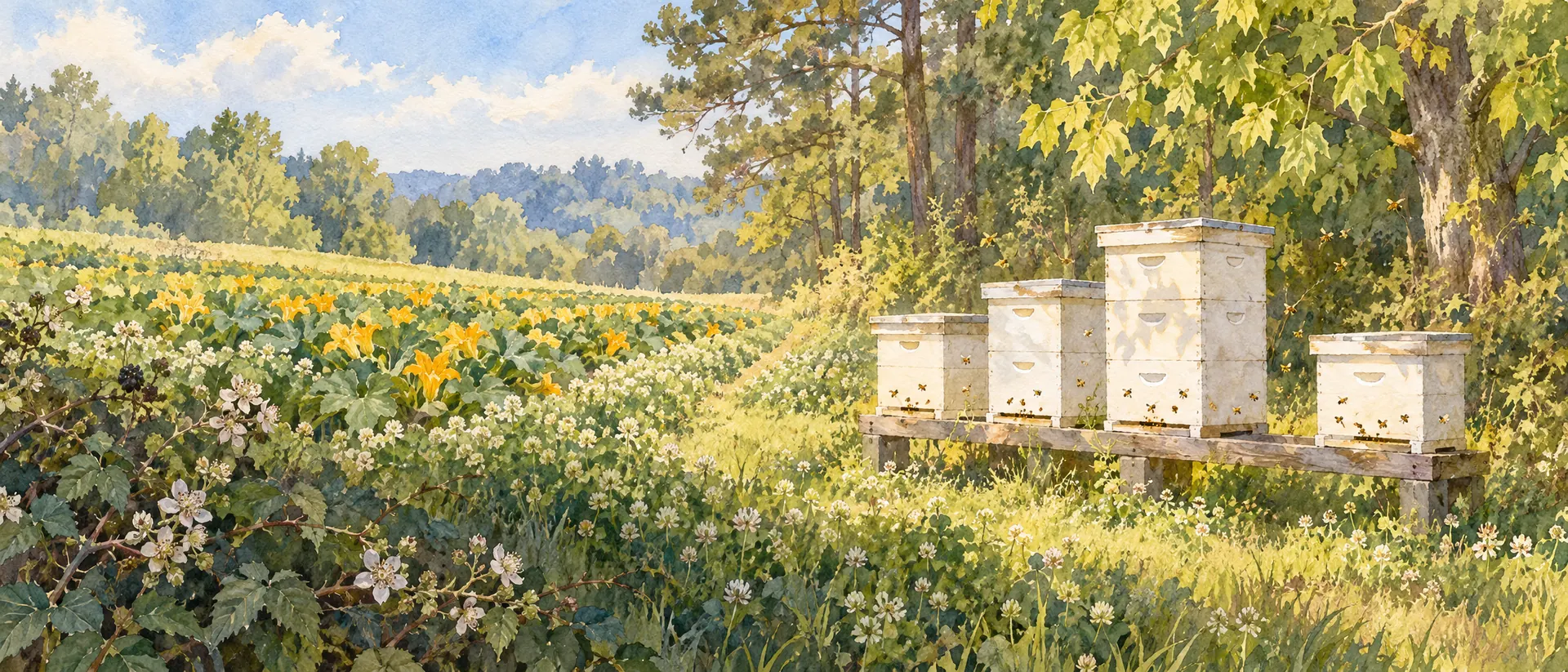
A watercolour painting of four white beehives on a stand at the edge of a field of flowering squash and clover A painting, not a photo of Gaye's hives

Gaye's Bee Hives

The smallest farmhands

Gaye keeps honey bees.

A good share of what a farm stand sells starts with a bee landing on a flower. This page follows the bees through the year here in the South Carolina Midlands.

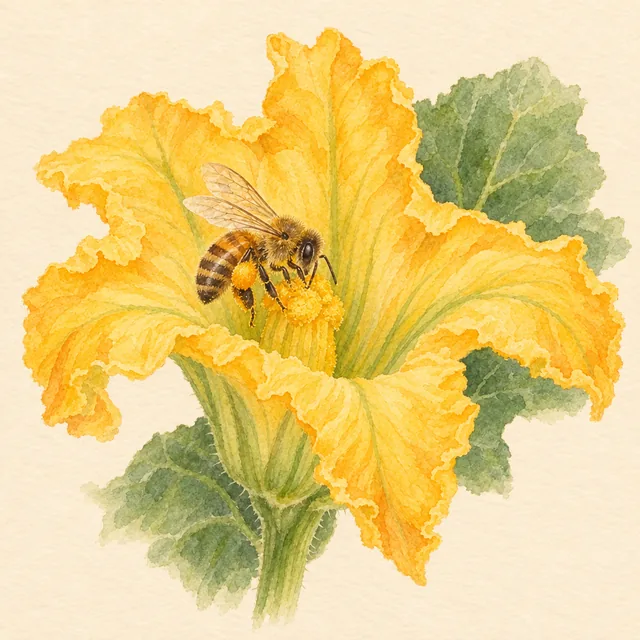
A watercolour painting of a honey bee landing on a yellow squash blossom

From the bee yard

Gaye's notes

Gaye's own notes are on the way: how she got started, how many hives she keeps, and how this year went.

Right now

Is it flying weather?

Honey bees are fair-weather fliers. They want it warm, dry, calm and light before they will leave the hive.

  • Below 50°They stay in a cluster and keep each other warm.
  • 50° to 55°Short trips out and straight back.
  • 55° and upForaging, as long as something is in bloom.
  • RainEveryone waits it out inside.
  • Wind past 20 mphToo rough for a loaded bee to land.
  • DarkHome by sundown, every night.

On the menu

What's in bloom for the bees

Around here the bees make most of their honey in April and May. Summer is the lean time, and goldenrod brings one more meal before winter.

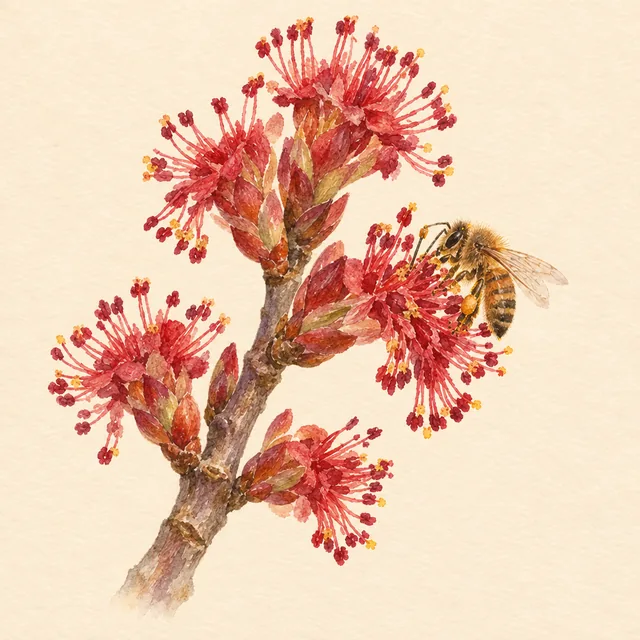
A watercolour painting of a honey bee on red maple flowers
Red maple, late winter
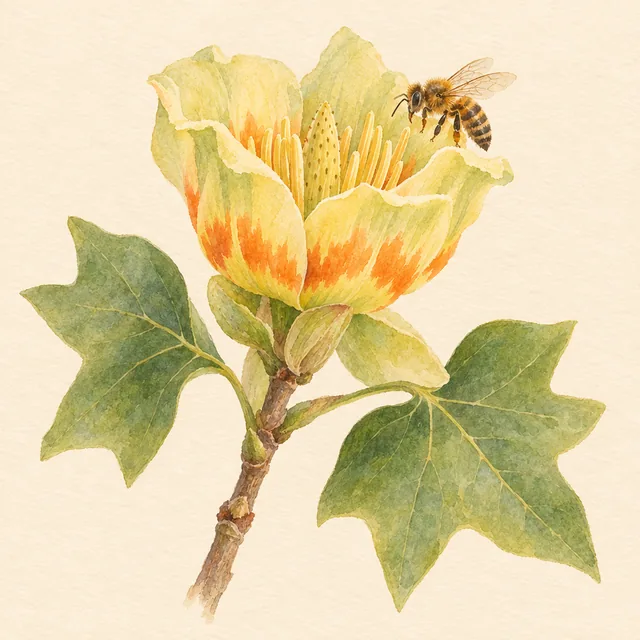
A watercolour painting of a honey bee on a tulip poplar flower
Tulip poplar, spring
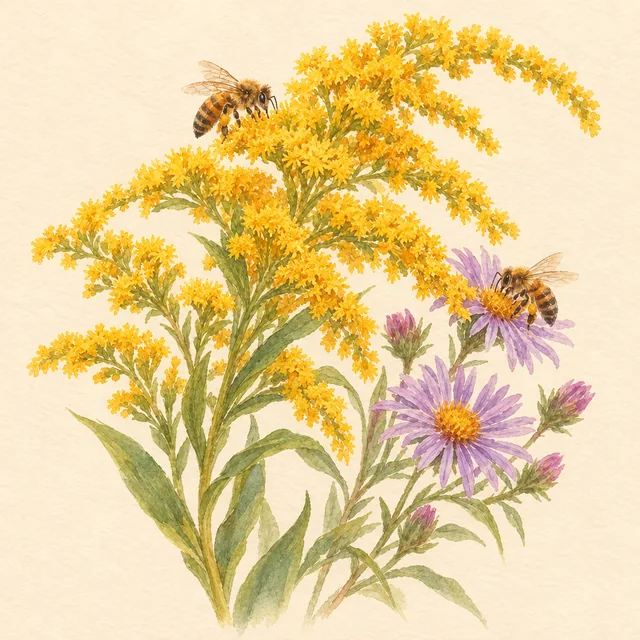
A watercolour painting of honey bees on goldenrod and asters
Goldenrod, fall

In the woods and field edges

Red mapleThe first pollen of the yearlate January to late February
Henbit and dandelionLawn weeds that feed the build-upearly February to late April
Redbudearly March to late March
Wild blackberryThe honey flow beginsearly April to early May
Tulip poplarThe big one for Midlands honeylate April to late May
Holly and privetearly May to early June
CloverWhite and crimsonearly April to late June
SumacA little help as summer sets inlate June to late July
GoldenrodThe fall flowlate September to late October
AstersThe last good meal before winterearly October to early November

In the fields and orchards

Peachesearly March to late March
Blueberriesearly March to early April
Strawberriesearly March to late April
Squash and cucumbersPlanting after planting, all summerearly May to late September
Watermelons and cantaloupeslate May to late July
Okralate June to late September
Pumpkinsearly July to late August

In the iris garden

Dot's irisesMostly a bumble bee's flowerearly April to late May
  • Wild flowers and trees
  • Crops
  • Irises
  • Main honey plants

Bloom times are what is usual for the Midlands. A warm or cold spring moves everything a week or two, and crops bloom by when they were planted. The big bearded irises in Dot's Iris Garden are built for bumble bees, which are heavy enough to push their way in. Honey bees mostly fly on by.

Month by month

The hive year in the Midlands

A colony grows and shrinks with the seasons. The longer the wedge, the bigger and busier the hive. Pick a month to see what is going on inside.

JanFebMarAprMayJunJulAugSepOctNovDec
  • Clustered
  • Building up
  • Honey flow
  • Summer dearth
  • Fall

January

Winter cluster

In the hive
The colony is packed into a tight ball around the queen, shivering its flight muscles to keep the middle warm. On a mild afternoon the bees pop out for a quick flight and hurry back in.
The beekeeper
Leaves the hive shut, lifts the back of it to feel how much honey is left, and builds frames for spring.
In bloom
Red maple starts to show red late in the month.

February

First pollen

In the hive
The days are getting longer and the queen lays more eggs. Foragers come home with the first pollen of the year on their back legs, and the nursery in the middle of the hive starts to grow.
The beekeeper
Checks food stores on a warm day. A growing colony eats through honey faster than a sleeping one.
In bloom
Red maple, henbit and the first dandelions.

March

Spring build-up

In the hive
Hundreds of new bees hatch every day and the first drones appear. This is the hungriest stretch of the year: there are many mouths to feed and a cold, windy week can stop the groceries coming in.
The beekeeper
Watches the food stores closely and adds room before the hive feels crowded. The first swarms can come this month.
In bloom
Redbud, peach and blueberry blossom, then strawberries.

April

Swarm season

In the hive
The hive is roaring. A crowded colony may split in two, with the old queen leaving in a swarm to find a new home. Then the nectar starts coming in faster than the bees can eat it, and they begin to put honey away.
The beekeeper
Stacks empty honey boxes on top to give the bees room, and keeps an eye out for swarms.
In bloom
Blackberry and clover, with tulip poplar opening by the middle of the month.

May

The honey flow

In the hive
Top speed. Tulip poplar is in full bloom and every forager that can fly is flying. In the Midlands most of the year's honey is made in April and May.
The beekeeper
Keeps adding boxes. A hive with nowhere left to store nectar stops collecting it.
In bloom
Tulip poplar, clover, holly and privet. Dot's irises are at their best, mostly for the bumble bees.

June

Honey harvest

In the hive
Early in the month the spring flowers fade and the flow winds down. The bees fan their wings over the honey to dry it, then seal each full cell with a cap of white wax.
The beekeeper
Takes off the capped honey and leaves the bees plenty of their own.
In bloom
The last clover, sumac, and squash and melons out in the fields.

July

Summer dearth

In the hive
Hot, humid and not much in bloom. On warm evenings bees hang on the front of the hive in a beard to keep the inside cool, and foragers haul water home instead of nectar.
The beekeeper
Makes sure there is water close by and good airflow, and leaves the bees their honey.
In bloom
Squash, cucumbers, melons and okra in the fields. Slim pickings in the woods.

August

Dearth and mite check

In the hive
The colony is shrinking on purpose, and tempers are shorter. With little to forage, strong hives will rob honey from weak ones if they get the chance.
The beekeeper
Counts varroa mites, the bees' worst pest, and treats if the number is too high. Narrows the entrance on small colonies so they can guard it.
In bloom
Okra, pumpkins and late squash.

September

Fall flowers

In the hive
Goldenrod turns the field edges yellow and the bees get a second, smaller flow. The drones have done their job, and the workers start pushing them out the door.
The beekeeper
Feeds any colony that feels light and keeps checking for mites.
In bloom
Goldenrod, then asters.

October

Getting ready for winter

In the hive
The bees raised now are winter bees. They are built to last for months instead of weeks, and they will carry the colony through to spring.
The beekeeper
Joins weak colonies together, feeds where needed, and closes the entrance down against mice and robbers.
In bloom
Asters and the last of the goldenrod.

November

Settling in

In the hive
On cold nights the bees pull together into a cluster. On warm afternoons they still fly, and a few come home with late pollen.
The beekeeper
Stores the empty boxes where wax moths cannot get at them.
In bloom
Very little. A few asters hang on until a hard frost.

December

The quiet month

In the hive
A tight cluster, slowly eating its way up through the honey above it. The hive stays shut.
The beekeeper
Reads, repairs equipment, and orders what next spring will need.
In bloom
Nothing much, until the red maples wake up in late January.

A general guide for central South Carolina, put in our own words from the South Carolina Beekeepers Association's calendar, the Mid-State Beekeepers Association and Clemson Extension. The wheel is a sketch of the pattern, not a count of bees. Every beekeeper and every year is a little different.

One family, three kinds of bee

Who's who in the hive

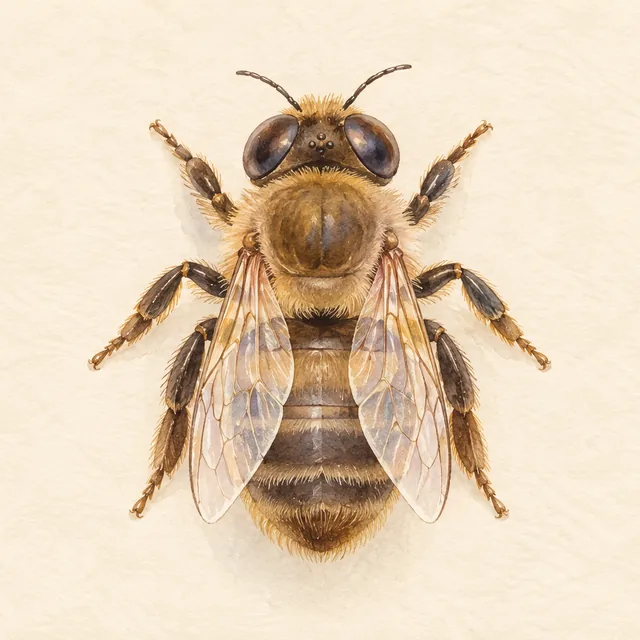
A colony is one big family: a single queen, her tens of thousands of daughters, and for part of the year a few hundred sons. Here they are painted to the same scale.

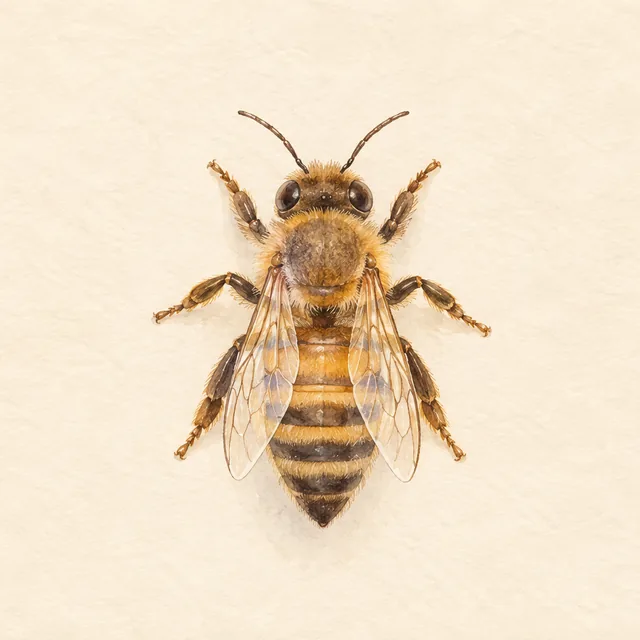
A painting of a worker honey bee seen from above: the smallest of the three, with a striped, pointed abdomen

Tens of thousands

Worker

Every worker is female. Workers do all the work of the hive: cleaning, nursing, building, guarding and foraging.

How many
20,000 to 60,000 in summer, far fewer in winter
Size
About half an inch
Egg to adult
21 days
Lives
About 6 weeks in summer, months over winter
Stinger
Barbed
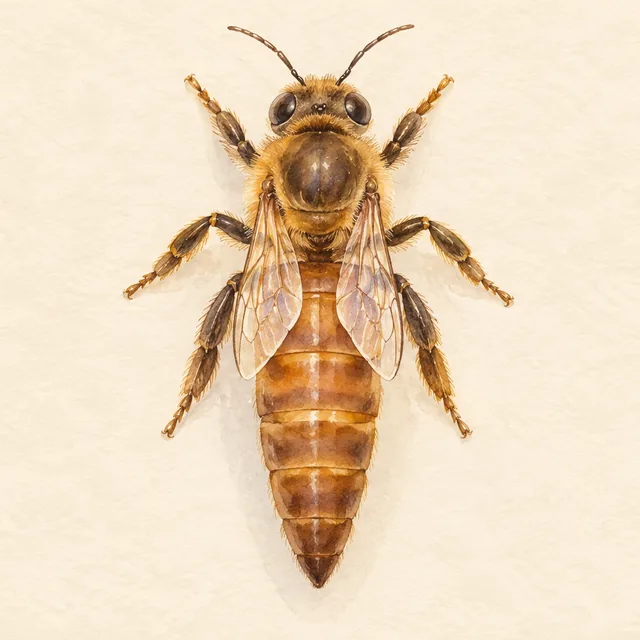
A painting of a queen honey bee seen from above: the longest of the three, with a long tapering abdomen that reaches well past her wings

Just one

Queen

The mother of nearly every bee in the hive. She lays the eggs, and her scent tells the colony all is well.

How many
One
Size
About three-quarters of an inch
Egg to adult
16 days
Lives
2 to 5 years
Eggs
As many as 2,000 a day in spring
Stinger
Smooth, used on rival queens
A painting of a drone honey bee seen from above: stout and blunt, with very large eyes that meet on top of his head

A few hundred

Drone

The males. A drone's one job is to mate with a young queen from another hive. He gathers no food and cannot sting.

How many
A few hundred to a couple of thousand, spring and summer only
Size
About five-eighths of an inch, and stout
Egg to adult
24 days
Comes from
An unfertilized egg
Stinger
None

A worker's life, job by job

A worker is not born into one job. She works her way through all of them, from the safe middle of the hive to the dangerous outside, in about six weeks.

  1. Days 1 to 2

    Cleaner

    Her first job is the cell she was born in. She polishes empty cells so the queen will lay in them again.

  2. Days 3 to 11

    Nurse

    Glands in her head switch on and she feeds the larvae, hundreds of visits a day. Some nurses tend the queen.

  3. Days 12 to 17

    Builder and storekeeper

    Her wax glands are at their best. She builds comb, takes nectar from returning foragers, packs pollen and fans the honey dry.

  4. Days 18 to 21

    Guard and undertaker

    She checks every bee at the entrance by smell, carries out the dead, and takes her first short flights to learn where home is.

  5. Day 22 on

    Forager

    The last and riskiest job: flying out for nectar, pollen, water and tree sap for as long as her wings hold up.

The ages are typical for a summer bee and they overlap. Workers switch early or late depending on what the colony needs, and bees raised in fall skip the schedule and live through winter.

How the home is laid out

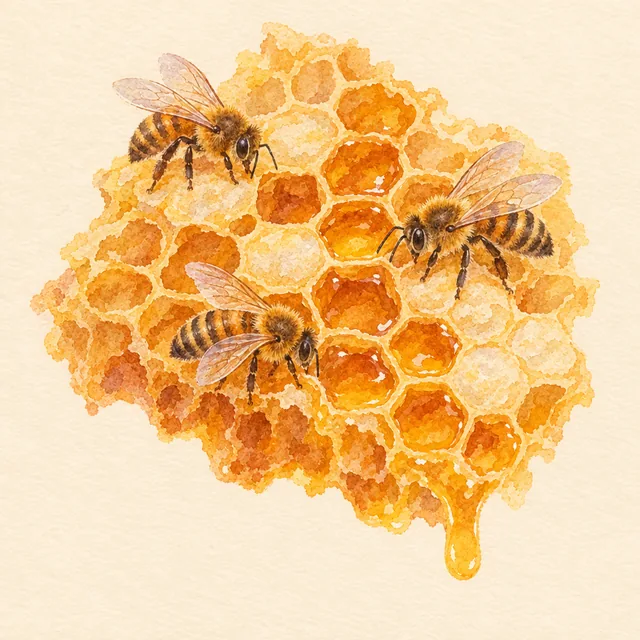
Bees keep the nursery in the warm middle, the pollen next to the babies that eat it, and the honey above and around the outside like insulation. A beekeeper's hive is built to match.

1 2 3 4 5
One frame of comb from the middle of the hive
  1. Capped honeyRipe honey sealed under white wax, across the top and in the corners.
  2. Pollen bandA ring of many-coloured pollen, packed in as "bee bread" right next to the brood.
  3. BroodEggs, larvae and capped pupae, kept at about 95° all year by the bees' own body heat.
  4. Drone cellsLarger cells with domed caps, usually along the edges, where the males are raised.
  5. Queen cellShaped like a peanut shell and hanging down. The colony builds one only when it needs a new queen.
1 2 3 4 5
A typical wooden hive, in layers
  1. RoofKeeps out the rain and the summer sun.
  2. Honey boxesShallow boxes the beekeeper adds on top in spring. This is the honey that gets harvested.
  3. Queen excluderA screen some beekeepers use. Workers fit through it and the queen does not, so no eggs are laid in the honey.
  4. Brood boxesThe deep boxes where the queen lays and the colony lives, with its own honey and pollen for winter.
  5. Floor and entranceOne doorway, watched by guard bees.

The frame is a tidy textbook picture and real comb is messier. The hive shown is the common stacked-box kind, drawn as an example. It is not a drawing of Gaye's hives.

For the science nerds

The parts of a honey bee

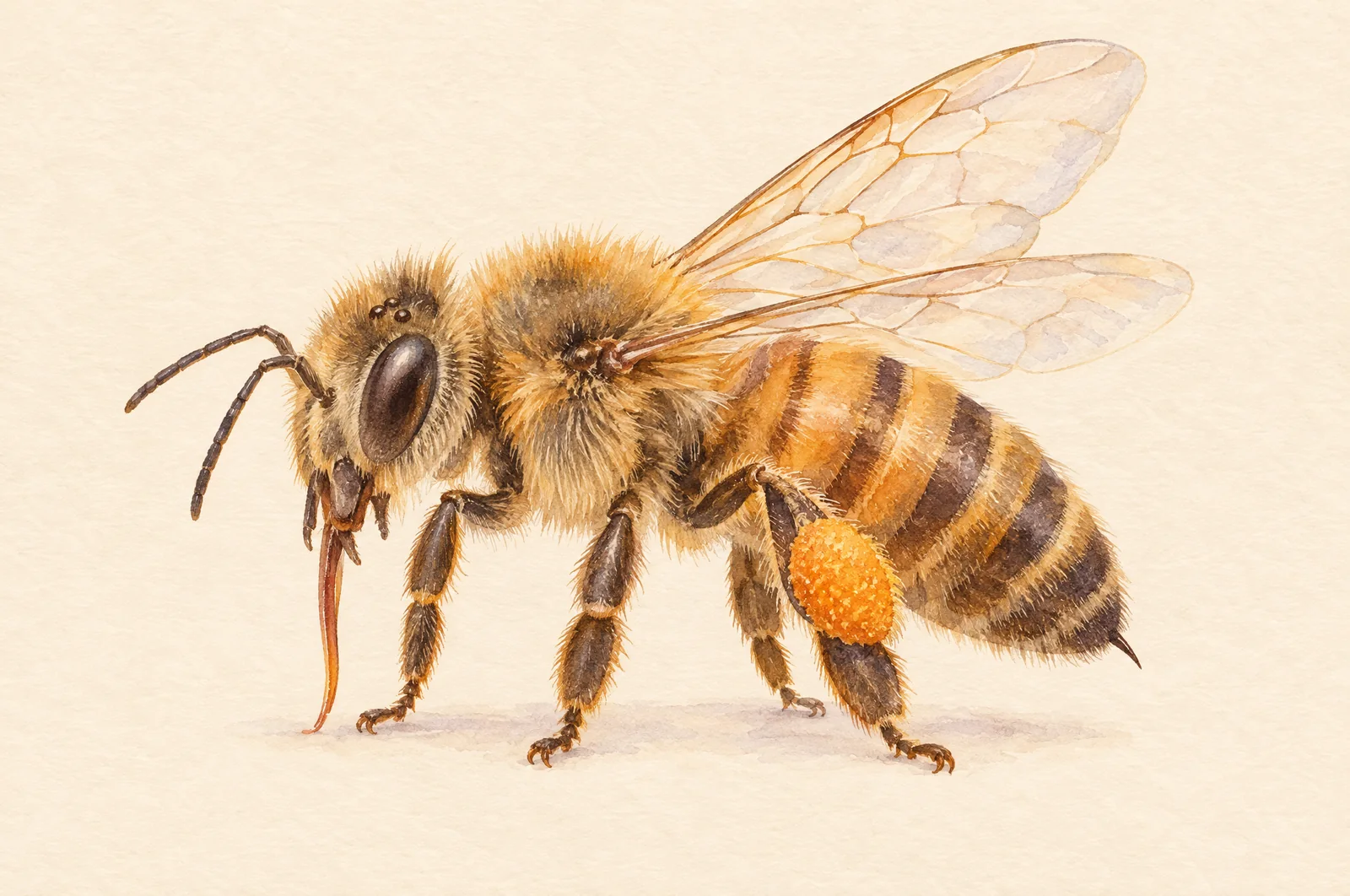
This is a worker, the bee you meet on a flower. Like every insect she comes in three sections: head, thorax and abdomen. Nearly every part of her is a tool for a job.

A watercolour painting of a worker honey bee seen from the side, with a ball of orange pollen on her hind leg and her tongue out. Its parts are numbered and named in the list that follows.

Tap a number or a name to find it in the list.

  1. HeadEyes, antennae and mouth on the outside. Inside are the brain and the glands a young worker uses to make food for the brood.
  2. Simple eyes ocelliThree small eyes on top of the head. They do not make a picture. They read how bright it is, which helps a bee steer by the light.
  3. AntennaeSmell, taste and touch in one, covered in thousands of tiny sensors. Inside a dark hive they do most of the sensing.
  4. Compound eyeOne on each side, made of several thousand tiny lenses. Very good at spotting movement. Bees see ultraviolet, but red looks black to them.
  5. Jaws mandiblesA bee's hands. They shape wax, carry out trash, groom nestmates and bite intruders.
  6. Tongue proboscisA long, hairy tongue that laps up nectar and water, and folds away under the chin when it is not in use.
  7. ThoraxThe engine room, packed with flight muscle. All six legs and all four wings attach here. Its branched hairs are what pollen sticks to.
  8. ForewingThe larger pair of wings. In flight the wings beat more than 200 times a second, which is the buzz you hear.
  9. Wing hooks hamuliA row of hooks along the front of each hindwing catches the forewing, so the two beat as one big wing. They are too small to see here.
  10. HindwingThe smaller pair. At rest the bee unhooks its wings and folds them flat over its back.
  11. AbdomenHolds the honey stomach, a tank for carrying nectar home, along with the gut. In a queen it is mostly ovaries.
  12. StingerBarbed in a worker, so it stays in your skin and she dies. A queen's is smooth and saved for rival queens. Drones have none.
  13. Wax glandsFour pairs, hidden under the abdomen. A worker in her second week sweats out clear flakes of wax and chews them into comb.
  14. Claws and padsEach foot has two claws for rough bark and a sticky pad for smooth leaves and glass.
  15. Pollen basket corbiculaA smooth hollow on each hind leg, fringed with stiff hairs. The orange ball is pollen, packed in for the flight home. Only workers have them.
  16. Middle legBrushes pollen off the body and passes it back to the hind legs.
  17. Front legEach front leg has a small notch, the antenna cleaner. The bee pulls an antenna through it to wipe off pollen and dust.

The bee is a painting made for this page, checked against Michigan State University's honey bee anatomy guide and the University of Arkansas Extension's pages on honey bees, which are also where the colony facts above come from. A bee has six legs. The painting shows the three on the near side and one of the far ones.

Why it matters at the stand

Which crops need a bee?

Some of what you carry home from a farm stand could not exist without a bee's visit. Tap a crop to see when it is usually at the stand.

No bee, no fruit

These plants make separate boy and girl flowers. Unless a bee carries pollen from one to the other, the little fruit shrivels and drops.

Better with bees

These can set some fruit on their own, but well-visited flowers make more of it, and bigger, fuller, better-shaped fruit.

Manage without

Corn is pollinated by the wind. Tomatoes, peppers and beans pollinate themselves. Greens and roots are picked long before they flower.

Small wonders

A few things about honey bees

  • 1/12of a teaspoonAbout how much honey one worker bee makes in her whole life.
  • 2 milesfrom homeHow far foragers will usually range from the hive to find flowers.
  • 21 daysegg to beeA worker goes from a new-laid egg to a grown bee in three weeks.
  • 6 weeksof summerA summer worker's whole life. Bees raised in fall live for months.
  • All girlsEvery bee you see on a flower is female. The drones stay home.
  • 55°and upAbout when honey bees start flying in earnest.
  • A dancefor directionsA forager waggles on the comb to tell her sisters which way and how far.

In your own yard

Four easy ways to help the bees

  1. Plant for the lean months

    Spring takes care of itself. Flowers that bloom in July, August and late winter are the ones bees are short of.

  2. Leave the clover

    Clover and dandelions in a lawn are a free meal. Mowing a little less often in spring is all it takes.

  3. Set out water

    A shallow dish with pebbles or corks to stand on gives bees a safe drink in the heat of summer.

  4. Mind the spray

    If you have to spray, keep it off open flowers and do it at dusk, after the bees have gone home. Always follow the label.

Found a swarm?

A football-sized cluster of bees hanging on a branch in April or May is a colony looking for a new home. They are usually gentle and often move on within a day or two. Please do not spray them. Your county's beekeeping club can usually send someone to collect them.

Find a local beekeeping club